

Is your application pushing standard FR-4 circuit boards to their limits? When extreme heat, high power, and rapid signals threaten to cause failures, it’s time to upgrade. Ceramic PCBs offer the thermal stability, reliability, and performance that innovators and engineers depend on for mission-critical projects.
If you’ve struggled with overheating, delamination, or unreliable signal performance from traditional PCBs, it’s time to explore how ceramic PCB material transforms what’s possible. This page will guide you through the technical advantages of ceramic PCB technology and how Millennium Circuits Limited (MCL) can help you meet your unique challenges.
What Is a Ceramic PCB?
A ceramic printed circuit board swaps out standard glass-reinforced epoxy materials, like FR-4, for advanced ceramic substrates. These substrates are typically aluminum oxide, also known as alumina, or aluminum nitride (AlN). These materials unlock significant improvements in heat dissipation, electrical properties, and long-term durability.
Manufacturing ceramic circuit boards involves bonding copper circuits directly to the ceramic base. Two key processes dominate:
- Direct bonded copper (DBC): DBC utilizes a high-temperature process to bond a thick copper layer onto alumina or AlN substrates.
- Direct plated copper (DPC): DPC involves directly plating a thin copper layer onto ceramic, allowing for fine features and high reliability.
Both methods ensure a reliable copper-to-ceramic interface, resulting in a rugged circuit board that can handle demanding operating environments.

Get a Free Quick Quote on a Ceramic PCB.

4 Key Advantages of Ceramic PCBs Over Standard (FR-4) Boards
Deciding between FR-4 and ceramic PCB solutions comes down to performance requirements. If your project demands superior heat management, frequency stability, and mechanical reliability, ceramic boards outclass standard options at every level.
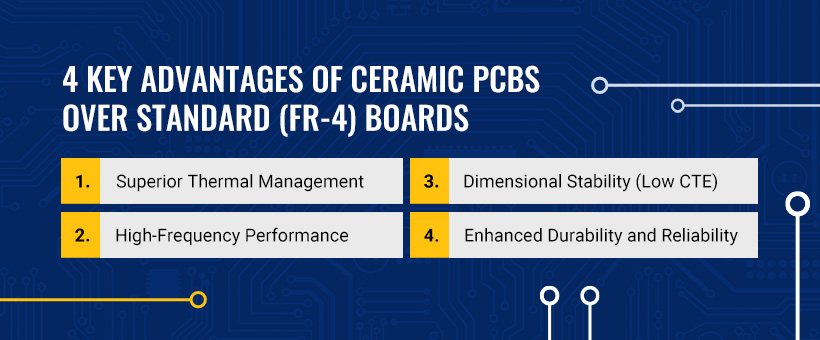
1. Superior Thermal Management
Ceramic substrates are engineered for heat dissipation. While FR-4 has low thermal conductivity, aluminum nitride provides very high bulk thermal conductivity, enabling efficient heat transfer through the substrate in high-power designs. This means ceramic printed circuit board designs can carry high currents or dense components with minimal risk of overheating, which is critical for high-power LEDs, automotive modules, and more.
High-temperature conditions further amplify the ceramic’s thermal ability, where the risk of board warping or thermal failure is a constant worry for designers working with FR-4. For applications that only need improved laminate stability, high-Tg FR-4 may be sufficient. However, when thermal conductivity, dimensional stability, or continuous high-temperature reliability exceed the limits of organic laminates, ceramic substrates such as alumina or AlN are the stronger choice.
2. High-Frequency Performance
Because of their stable dielectric properties and low electrical loss, ceramic PCBs are the preferred platform for RF and microwave electronics. FR-4 quickly loses signal integrity as frequencies rise, but ceramic’s predictable dielectric constant and minimal signal loss ensure accuracy in mission-critical wireless, radar, and communication systems.
3. Dimensional Stability (Low CTE)
The Coefficient of Thermal Expansion (CTE) describes how much a material expands with increasing temperature.
Ceramic circuit boards made from alumina have a CTE of 7 ppm/° Celsius. PCBs made from AlN more closely match Silicon’s CTE (~3 ppm/° Celsius) with a remarkably low expansion rate of roughly 4.5 ppm/° Celsius. By contrast, FR-4 can reach as high as 17 ppm/° Celsius.
4. Enhanced Durability and Reliability
Although ceramics are inherently brittle, properly designed, mounted, and metalized technical ceramic substrates can be highly reliable in harsh environments. The unique chemistry of technical ceramics, such as alumina and AlN, provides an outstanding hardness and impressive chemical and moisture resistance. This ceramic circuit board material is reliable in harsh industrial and aerospace settings, and ongoing advancements are making ceramics even more resilient.

MCL’s Ceramic PCB Capabilities
As an established custom ceramic PCB provider, MCL is ready to support your design from prototype to high-volume production. We deliver precise, high-performance ceramic PCB solutions engineered for the most demanding thermal and electrical environments.
Ceramic Material Options
Our ceramic circuit boards are available in two advanced material options, each engineered for specific performance needs. Selecting the right ceramic substrate is essential for optimizing thermal management, reliability, and cost-effectiveness in demanding applications:
- Alumina: This material is the workhorse of ceramic PCB substrate materials, offering great thermal conductivity. This material is ideal when cost-effectiveness and reliable thermal performance are vital.
- AlN: AlN provides breakthrough thermal performance with high conductivities. This material is best suited for applications where every degree of heat matters, such as for high-power RF amplifiers, laser drivers, or power conversion.
In addition, MCL can support other ceramic materials such as boron nitride, beryllium oxide, and silicon carbide to meet specialized requirements. If your application needs a specific ceramic substrate not listed here, our team can help you explore the best material choice for your project.
Core Capabilities and Specifications
MCL provides a comprehensive suite of capabilities to meet diverse ceramic PCB requirements, ensuring high quality and performance for every application. Our ceramic PCBs are available using both alumina and aluminum nitride substrates, supporting a variety of board thicknesses to accommodate unique design needs. We also offer multiple copper thickness options to allow for precise control over conductivity and thermal performance.
Common surface finish types may include ENIG or ENEPIG. Electroless nickel, silver, or gold options may be available depending on the ceramic technology and application. Confirm the final finish selection based on the fabrication process and operating environment. High-temperature solder mask and marking are available when necessary, and via types include filled, plated, and plugged configurations for optimal electrical and mechanical reliability.
We produce each ceramic board under rigorous quality standards, including ISO 9001:2015 and IPC compliance, giving engineers and buyers confidence in both performance and durability. If your project requires unique specifications or advanced customization, our team is ready to help engineer a solution tailored to your requirements.
Common Applications for Ceramic PCBs
Ceramic PCBs are the foundation of reliable performance in advanced industries and severe environments. Typical real-world uses include:
- High-power LED lighting: Thermal demands of dense LED arrays require ceramic PCB material for effective heat spreading.
- Automotive sensors and controls: These under-hood electronics are often subject to vibration, temperature swings, and chemical exposure, making ceramic PCBs ideal.
- Aerospace and defense electronics: Where stable performance and failsafe reliability are nonnegotiable, ceramic PCBs are a top choice
- RF and microwave amplifiers: Ceramic PCBs enable high-frequency circuitry with stable impedance and minimal signal distortion.
- Medical electronics: Ceramic substrates are used in high-reliability medical electronics and may be suitable for implantable or physiological environments, when the complete material stack and assembly are qualified for biocompatibility and sterilization requirements.
Why Trust MCL for Ceramic PCBs?
As a partner to thousands of engineers and manufacturers, MCL stands apart as a trusted ceramic printed circuit board supplier because of our technical expertise, flexible engineering support, and full commitment to quality.
With us, you can expect:
- No minimum order quantities: Whether you’re prototyping or in full production, you’ll always receive the same attention to detail and technical support.
- Fast lead times and clear communication: Our responsive team guides you through every step, from quote to delivery.
- Proven credentials: We are ISO 9001:2015 certified and fully compliant with global quality and environmental standards.
Whether you’re specifying your first ceramic PCB or need advanced customization for a new design, we deliver the technical guidance and manufacturing capabilities that demanding applications require.

Contact MCL to Get Started
Experience the difference with MCL, and discover how easy it is to bring your design to life. When you are ready to solve your thermal, signal, or reliability challenges with custom ceramic PCB solutions, contact us to connect with an expert. We’ll guide you every step of the way, from material selection through delivery.