

For several months, MCL has been communicating about growing pressure across the PCB supply chain.
We’ve shared updates on rising material costs, tightening quick-turn capacity, longer lead times, changing material availability, and the importance of planning ahead.
Until recently, many of these constraints have been manageable, with sufficient material availability to support most production needs.
That is changing.
Material shortages are now affecting a broader range of PCB requirements, while lead times, pricing, and available manufacturing capacity continue to face pressure. This is an industry-wide issue, and we expect supply constraints to remain a factor for the foreseeable future.
For PCB buyers, supply chain managers, and manufacturers, this is no longer simply a developing trend to watch.
The time to act is now.
If you have known PCB requirements for the remainder of 2026 or into the first half of 2027, now is the time to evaluate your needs and take steps to protect your supply.
From a Pricing Challenge to a Supply Challenge
Rising PCB material costs have received considerable attention over the past year—and for good reason.
Copper-related inputs, fiberglass cloth, laminates, precious metals, and other PCB manufacturing inputs have all experienced pricing pressure.
But price is only part of the issue. As material availability tightens and manufacturing utilization increases, the ability to secure supply and production capacity becomes just as important as cost.
A material that costs more can often be managed. A material that isn’t available when your production schedule requires it can put an entire program at risk.
That’s why the conversation is shifting from simply “What will this board cost?” to “Can I get the boards I need, when I need them?”
Why Acting Early Matters
Supply chain planning works best when you still have options.
Once a required material becomes constrained or manufacturing capacity is committed, those options begin to narrow. Instead of planning strategically, purchasing and supply chain teams are forced to react.
That can mean:
- Longer lead times
- Reduced manufacturing flexibility
- Additional price increases
- Limited material choices
- Difficulty accommodating expedited requirements
- Greater risk to production schedules
MCL’s recommendation is straightforward: If you know the demand is coming, don’t wait for your normal purchasing window to begin planning for it.
Don’t get stuck in line.
Three Steps PCB Buyers Should Take Now
There isn’t one solution that applies to every PCB program. But there are several steps MCL recommends customers consider now.
- Increase Forecast Visibility: Work internally and with your customers to develop as much visibility into anticipated PCB demand as possible. Where possible, MCL recommends providing 6–12 months of forecast visibility. The earlier we understand your anticipated requirements, the more opportunity our team has to work with our manufacturing partners to evaluate material availability, capacity, timing, and sourcing options before those requirements become urgent.
- Place Orders Earlier: Traditional PCB ordering cycles may not provide sufficient protection in the current environment. Where practical, consider releasing orders 4–5 months earlier than normal, particularly for recurring requirements and critical programs. Earlier commitments provide more opportunity to secure materials and manufacturing capacity before availability becomes constrained.
- Secure Recurring Demand: If you have predictable recurring requirements, consider whether a larger blanket order or inventory program makes sense. MCL has developed SupplyShield specifically to give qualifying customers another option for protecting predictable PCB demand.
MCL SupplyShield: Greater Predictability in an Unpredictable Market
SupplyShield allows qualifying customers to secure production for known requirements, with MCL holding finished inventory for scheduled releases for up to six months.
For the right programs, this can help customers:
- Lock PCB pricing for an established period
- Secure material and production capacity earlier
- Reduce exposure to ongoing market volatility
- Improve budgeting and forecasting
- Reduce material-related production risk
- Have finished inventory available for planned releases
Instead of returning to a changing market every time another production run is required, customers can create greater predictability around demand they already know is coming.
SupplyShield isn’t the right solution for every board or every customer. That’s why MCL evaluates each opportunity based on the specific requirements and anticipated demand.
What Could Acting Early Be Worth?
The potential value isn’t limited to supply continuity. Acting early can also provide meaningful financial protection.
Consider an illustrative customer with approximately $250,000 in annual PCB spend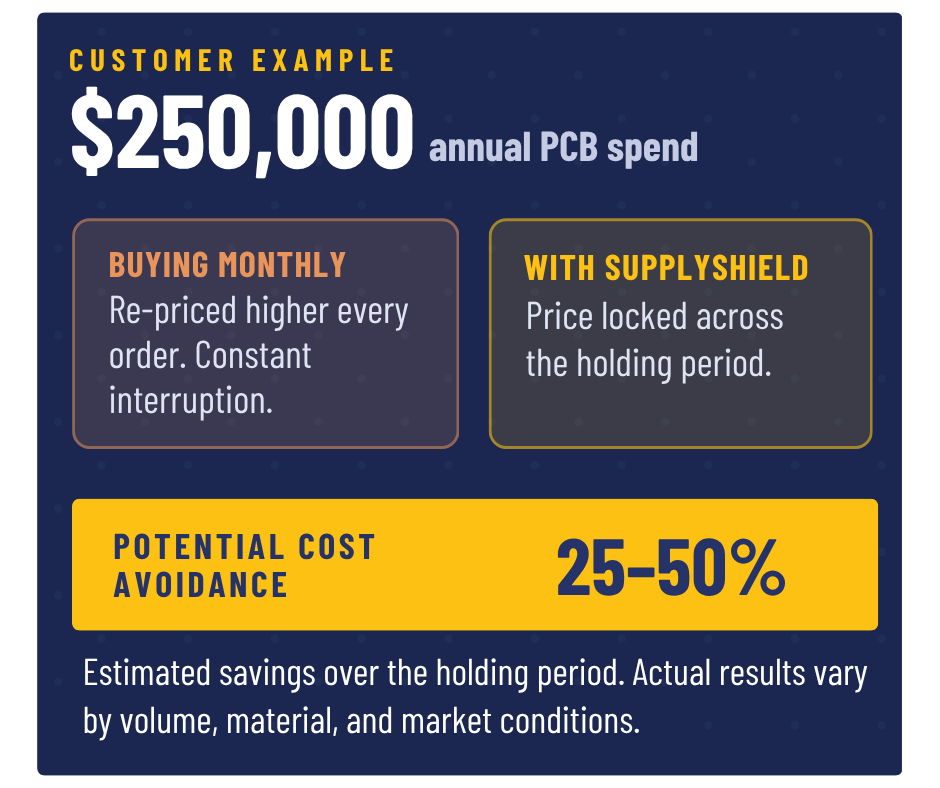 .
.
Six months of demand at roughly $21,000 per month represents approximately $126,000 at today’s pricing.
In a scenario where market costs increase 10–15% month over month, purchasing those requirements incrementally could result in approximately $162,000 in total spend.
Potential cost avoidance: approximately $36,000 over six months.
Actual savings will vary based on the board, materials, timing, and market conditions. Future price increases cannot be predicted with certainty.
And that’s precisely the point.
SupplyShield isn’t about trying to predict what the market will do next. It’s about reducing your exposure to it.
MCL Has Been Preparing—Not Reacting
For MCL, keeping customers informed about supply chain conditions is part of being a true PCB partner.
We have been closely following market conditions, communicating regularly with our manufacturing partners, and sharing what we’re seeing with customers as these pressures have developed.
And we haven’t simply been watching the market change.
We’ve been preparing for it.
MCL is actively working across our manufacturing network, monitoring material availability and capacity, identifying potential risks, and evaluating options before those risks reach customer production schedules.
Our stable foundation, strong manufacturing partnerships, and visibility across our global network position us to help customers anticipate risk, secure options early, and keep critical programs moving.
That’s an important distinction in a volatile market.
Anyone can react to a shortage once it happens. A true supply chain partner helps you prepare before it does.
Don’t Wait Until Your Options Are Limited
Customers who plan early and secure known requirements now will be in the strongest position to have product available when they need it.
If you have known PCB requirements for the remainder of 2026 or into the first half of 2027, the time to act is now.
Talk with your MCL Account Executive or Customer Concierge about your upcoming PCB requirements: Contact MCL today.
Where Demanding PCB Requirements Meet Relentless Execution.